ThinkEmpire — Landing Page Redesign
A growth-focused UI transformation for a commercial real estate data platform — from confusing splash page to conversion engine.
Overview
There's always business pressure in a UX/UI role, and for ThinkEmpire — an innovative data terminal for the commercial real estate industry — the most urgent need was clear: the splash page wasn't converting. Potential users were landing, getting confused, and leaving before ever experiencing the product's power.
This case study documents a 4-month redesign journey that transformed the platform's public-facing landing page from a passive brochure into an active, conversion-focused experience.
The Problem & Opportunity
ThinkEmpire needed to generate revenue through user memberships, but their splash page was failing at its most basic job: explaining what the product does and motivating visitors to sign up.
The opportunity was threefold: update the visual design to feel modern and trustworthy, reorganize information architecture to guide users toward sign-up, and introduce interactive elements that let potential customers feel the product before committing.
What wasn't working
Users were clicking static images expecting them to be interactive. The platform's most powerful features — its deep search engine and rich data filters — were invisible on the splash page. There was no clear conversion path and no social proof to build trust with skeptical real estate professionals.
What we set out to build
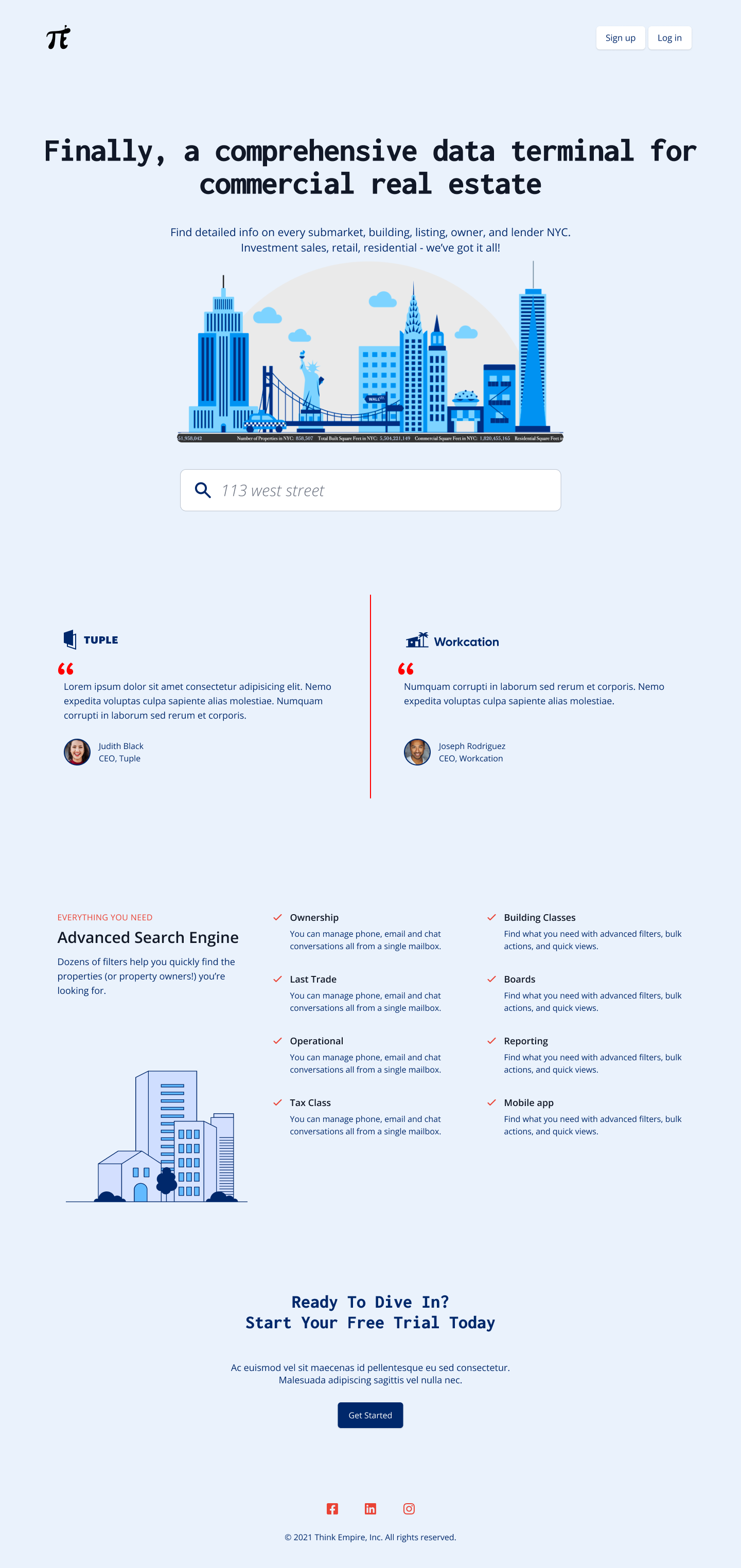
A redesigned landing page with a homepage search bar, clearly communicated feature set, testimonials from trusted industry names, and a footer CTA — all within a modern, airy visual system that reflected the product's ambition rather than its legacy.
Discovery & Research
I used multiple research methods — Google Analytics, stakeholder interviews, and Hotjar session recordings — but Hotjar proved to be the most immediately actionable tool for understanding what was happening on the splash page.
After lobbying to get Hotjar implemented, I watched session recordings to understand where users were getting stuck or dropping off. The findings were eye-opening: users were behaving in ways the original design never accounted for.
Beyond behavioral analytics, I conducted deep industry research to understand the specific needs and habits of commercial real estate professionals — a user base with very particular patterns and a heavy reliance on data credibility and peer trust.
Competitive Analysis
I analyzed both direct competitors in the real estate data space and aspirational references from modern SaaS splash pages. My goal was to understand how the best-performing pages balanced education with conversion — and find the white space where ThinkEmpire could stand out.
PropertyShark
Clickable data points and listings demonstrate the product in action. Strong testimonials appeal to an industry that runs on referrals and community trust.
Visually disorganized with no coherent brand identity. Outdated metrics from 2021 signal neglect. No clear conversion hierarchy.
CoStar
Inline sign-up form reduces friction. Large, prominent metrics are compelling for data-driven users and establish authority immediately.
Boxy, hard to read, and visually flat. Laptop mockups "say" rather than "show" the product. Does the bare minimum to explain functionality.
Zillow stood out as an inspirational reference — not as a direct competitor, but as a model for how a real estate product can feel airy, approachable, and immediately useful. The homepage search pattern, illustrative style, and concise feature communication were all worth studying.
The competitive analysis gave upper management a clear picture of where ThinkEmpire could differentiate: modern visual design, interactive search on the homepage, and a smarter use of social proof tailored to real estate professionals.
Information Architecture
Research directly shaped the page architecture. Rather than layering on content, I stripped back to what would genuinely move users from curiosity to conversion — and ordered it to match how real estate professionals actually think.
Total visual redesign
Replace the rigid, dated aesthetic with a modern, airy feel. Calming blue brand color, sans-serif type, no color-blocked sections. Reference Material.io spacing and accessibility standards throughout.
Homepage search bar
Hotjar proved users expected to search directly from the homepage. A prominent search under an H1/H2 headline lets users feel the product immediately and demonstrates its core value proposition.
Explain the search engine
The platform's deepest value is its filtering power. Clearly listing refinement options — ownership, tax class, building class, operational data — makes this concrete rather than abstract.
Testimonials & metrics
Real estate professionals depend on peer trust and quantified results. Social proof from industry-recognized companies, paired with platform metrics, builds the credibility needed for a paid subscription.
Footer CTA
After consuming the full page, users needed a second, lower-friction invitation to act. A clean footer CTA captures those who read everything before deciding.
Visual Identity
I was working within the Tailwind UI design system to stay in sync with development, which meant working creatively within constraints rather than starting from a blank canvas. The logo was off-limits — but nearly everything else was open for evolution.
My direction: a calming blue as the new brand backdrop (distinct from a plain white background, but still clean and spacious), transitioning to a deep navy for dark mode. I replaced all serif body fonts with a modern sans-serif to remove the rigidity of the legacy design. Color-blocked sections were eliminated in favor of a single flowing page that breathes.
Every spacing decision was checked against Material.io's accessibility recommendations — a deliberate move to set a higher bar than the existing design had held.

User Testing
With a high-fidelity prototype and finalized copy in hand, I conducted in-person usability testing with 12 internal users — all working in the same building, which made direct observation possible. I wrote a structured script of scenarios covering the homepage, the learn page, pricing discovery, and sign-up — with both pre and post-test questions to capture qualitative and quantitative results.
"You heard about this site from a friend. You've arrived on the homepage. What's the first thing you notice? What do you expect to happen when you take that action?"
"You want to understand what ThinkEmpire is. Without doing anything, where would you look? Why would you look there?"
"You want to know how much it would cost your brokerage to use ThinkEmpire. Where would you navigate? What do you expect to find?"
"You've learned enough and want to sign up. How would you find where to enter your payment information?"
Results
The testing results were strong. The visual redesign alone had a measurable impact on user willingness to engage — and the new homepage search pattern proved its value even among users who were accustomed to a different flow.
of test users said they were more likely to read the page copy simply because of the aesthetic changes — a clear signal that visual trust is a conversion lever.
said they would use the search bar directly on the homepage — validating the core architectural decision and Hotjar's behavioral insights.
The remaining 28% who preferred to log in first weren't a failure — they were likely habitual users whose existing flow was deeply ingrained. The important thing was that the search was now available, frictionless, and clearly understood for the first time.
If I had to design the test differently, I would have recruited external potential users — not just internal ones — to capture first-impression data from people encountering the product cold.
Final Thoughts
"Your splash page is your first conversation with a user. It can build trust and create intrigue — or it can drive them away before they ever understand what you've built."
This project was a master class in how design, research, and business goals intersect. I studied an entirely new industry, learned to work within a developer's design system, and led a process that touched identity, architecture, copy, and testing — all for a single page.
The transformation was about more than aesthetics. We gave the platform a coherent brand voice, made the sign-up flow discoverable, and used behavioral data to make decisions that actually matched how users behaved — not just what stakeholders assumed they'd do.
Finishing this project left me hungry for the next challenge: getting into the actual platform experience, so we could not only attract new users — but keep them.
new website:
dominiquegrogandesign.com
Design Case Studies


